Google updated its Site Reputation Policy on Aug 28, 2026, and the direction is simple: third-party content that rides on your domain’s authority is an even bigger liability now—especially when it’s clearly there to rank, not to serve your audience.
This is the ongoing crackdown on what the industry calls “parasite SEO”: a brand with trust publishes (or hosts) content that didn’t earn that trust, and the content benefits from the site’s reputation. Google has been talking about this since 2024; this update is them tightening the screws again. Here’s the primary source: Google’s Aug 28, 2026 update to the Site Reputation Policy.
What changed (and what didn’t)
Google’s message is not “don’t publish third-party content.” It’s “don’t publish third-party content to exploit your site’s reputation.” That nuance matters because plenty of legitimate businesses use outside contributors, licensed data, affiliate partnerships, or community submissions.
What’s changed is the risk profile. The bar for “this looks like reputation renting” is getting lower, and the consequences are getting less theoretical. Even if you never see a manual action, algorithmic suppression is enough to quietly wipe out the ROI of a whole content section.
One phrase you’ll hear a lot is “site reputation abuse.” That’s the label Google uses. The overhyped part: some SEOs are acting like every guest post and every affiliate page is now toxic. That’s not what Google is saying. The real target is content that’s disconnected from the host site’s purpose and is there because the host domain is strong.
Why business owners should care (even if you’re not a publisher)
This policy doesn’t only hit newspapers and big media sites. We see the same pattern in everyday commercial sites:
Local service brands adding a “Best casinos” blog category because an agency pitched “easy traffic.” SaaS companies launching “student discounts” directories under /resources/ because a partner offered to fill it. Ecommerce sites hosting thin “reviews” subfolders managed by a third party. It all feels harmless—until rankings slide across the whole domain.
The business risk isn’t just losing traffic to those pages. It’s collateral damage: the trust signals your money pages depend on can get diluted when Google starts questioning who your site is really for.
Everyone will miss this: this is as much a brand governance problem as an SEO problem. If your sponsorship, partnerships, PR, and content teams can publish pages without SEO review, you’re exposed. The sites that win will be the boring ones with clear editorial control and clean technical boundaries.
Where we’re seeing the danger: subfolders, subdomains, and “operated by” pages
Most parasite SEO setups hide in plain sight. They usually have at least two of these signals:
- A section of the site that doesn’t match the brand’s core offering (think: a logistics company hosting a credit card comparison hub).
- Different tone, templates, authorship, or publishing cadence than the rest of the site.
- Commercial intent that benefits a third party more than the host brand.
- Editorial disclaimers like “in partnership with…” that are meant for legal cover, not user value.
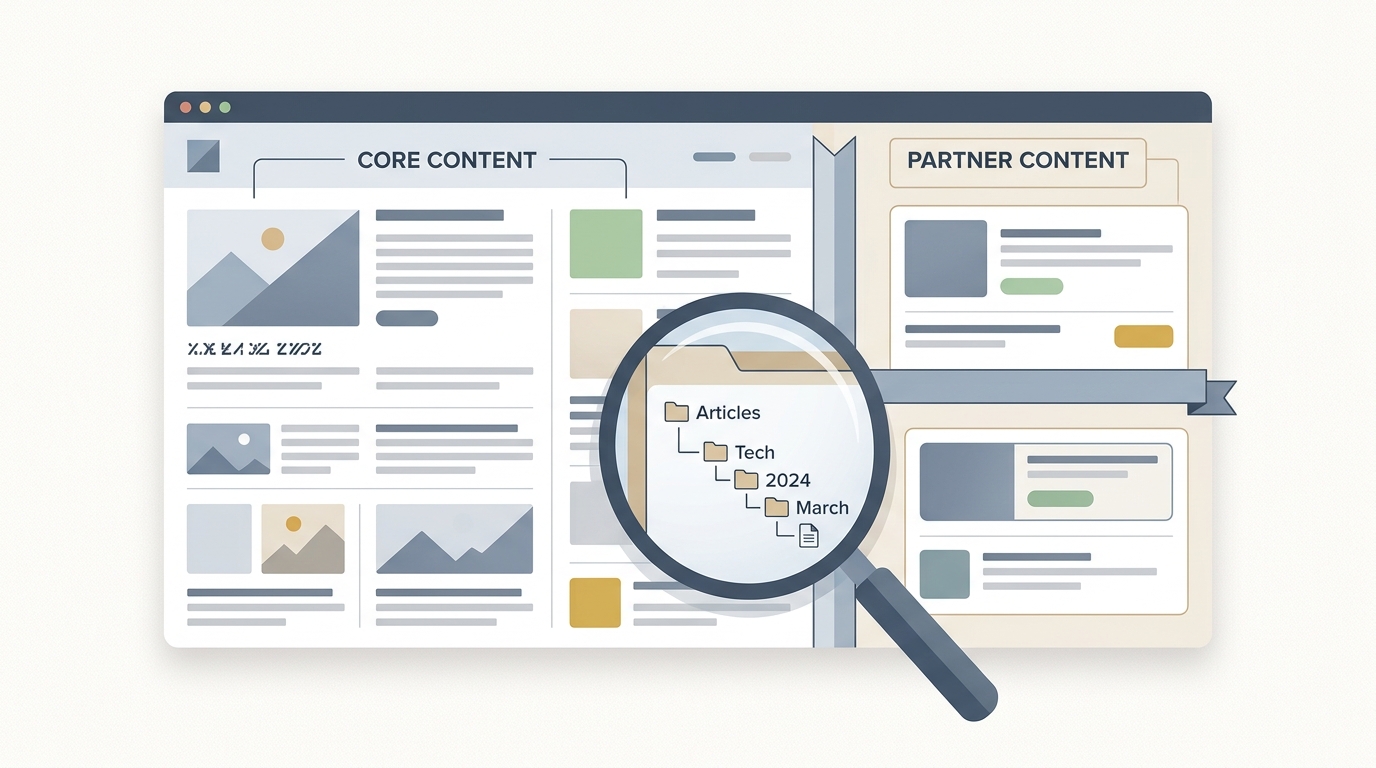
Technically, it often lives in a subfolder because that’s the whole point: inherit the domain’s authority. But we also see it on subdomains that are interlinked heavily and visually presented as part of the main site. If it walks like part of your brand, Google can treat it like part of your brand.
Operationally, it tends to be “managed by a partner.” That should be a flashing red light. If your team can’t confidently answer who wrote it, who edited it, and why it exists, you don’t control it—and Google is telling you control matters.
What this means for your site (do this in the next 30 days)
- Inventory third-party content: list every directory, hub, /blog/ category, “deals” section, and sponsored area; mark who creates it and who approves it.
- Audit intent alignment: for each section, answer in one sentence: “Why would a customer of our core product want this?” If you can’t, it’s a candidate for removal or separation.
- Fix ownership signals: add clear authorship, editorial review, and brand accountability where content is legitimate. If it isn’t legitimate, don’t dress it up—retire it.
- Harden your publishing workflow: no partner gets a direct publishing path without guardrails. We usually recommend a gated CMS role + SEO checklist + monthly section-level performance review.
- Create technical boundaries where needed: if a partnership must exist, consider isolating it so it doesn’t borrow trust from your core domain. The right answer varies—sometimes it’s a separate domain, sometimes it’s noindex, sometimes it’s killing it.
Our take: who wins, who loses
Winners: brands that publish fewer pages but can defend every page. Sites with strong editorial oversight. Companies that invest in first-party expertise and ship content that matches their actual product and customer questions. Teams already working with an accountable SEO services team and a real measurement loop.
Losers: sites that treated their domain like a billboard. Publishers that sold “sponsored SEO” packages. Businesses that let partners run content operations under /guides/ or /news/ without oversight. Also: agencies promising “we’ll add 500 pages a month” with vague ownership. That model is getting harder to justify.
Effort/impact estimate from what we’re doing with clients: an initial audit and decision plan is usually 1–2 weeks. Cleanup can be another 2–6 weeks depending on how tangled the CMS and contracts are. The upside is defensive: you’re avoiding a slow bleed that can take quarters to recover from.
What we’re changing on client sites this week
Three concrete moves we’re rolling out immediately:
1) Section-level risk mapping. We’re pulling Search Console and analytics by directory, then pairing it with a “content provenance” check (who wrote it, who approved it, what the business goal is). If the answers are fuzzy, that section goes into a remediation queue.
2) Partner-content contract reality checks. If a partner is compensated based on traffic or rankings, that’s a misaligned incentive. We’re pushing clients to renegotiate deliverables toward user outcomes (leads, trials, subscriptions) or end the arrangement.
3) Technical separation planning. For sites where the business insists on keeping a questionable section (usually because it makes money), we’re scoping options through web development support: tighter templates, better labeling, noindex where appropriate, and reduced internal linking so the whole site doesn’t become a passenger on that risk.
One more thing that’s being under-discussed: Google is expanding reporting and visibility across platform content in Search Console, which increases the pressure to manage brand-wide discoverability, not just your website. The related announcement is here: Google’s platform properties rollout and social/video performance guide. It’s not the same policy, but it’s the same direction—more scrutiny, more diagnostics, less room for “set and forget.”
If you do nothing for 90 days
Best case: nothing obvious happens, and the risky section keeps limping along. That’s what makes this dangerous—there may be no single “drop day,” just a gradual loss of visibility and a harder time ranking new pages.
Worst case: a manual action lands on the offending section, your rankings fall, and you have to do the cleanup under pressure while revenue is down. Recovery is slower when Google thinks the incentive structure hasn’t changed, not just the pages.
If you’re unsure whether you have a parasite SEO exposure, assume you do until you’ve audited your directories. This is also the month to align SEO and PR so “sponsored content” doesn’t quietly become an SEO liability—our digital PR work increasingly includes governance rules for what gets published where.
Want us to sanity-check your highest-risk sections and give you a keep/kill/isolate plan? Book a free consultation call and we’ll tell you what we’d change first.
Primary source: Google Search Central Blog